

 Christina Nixon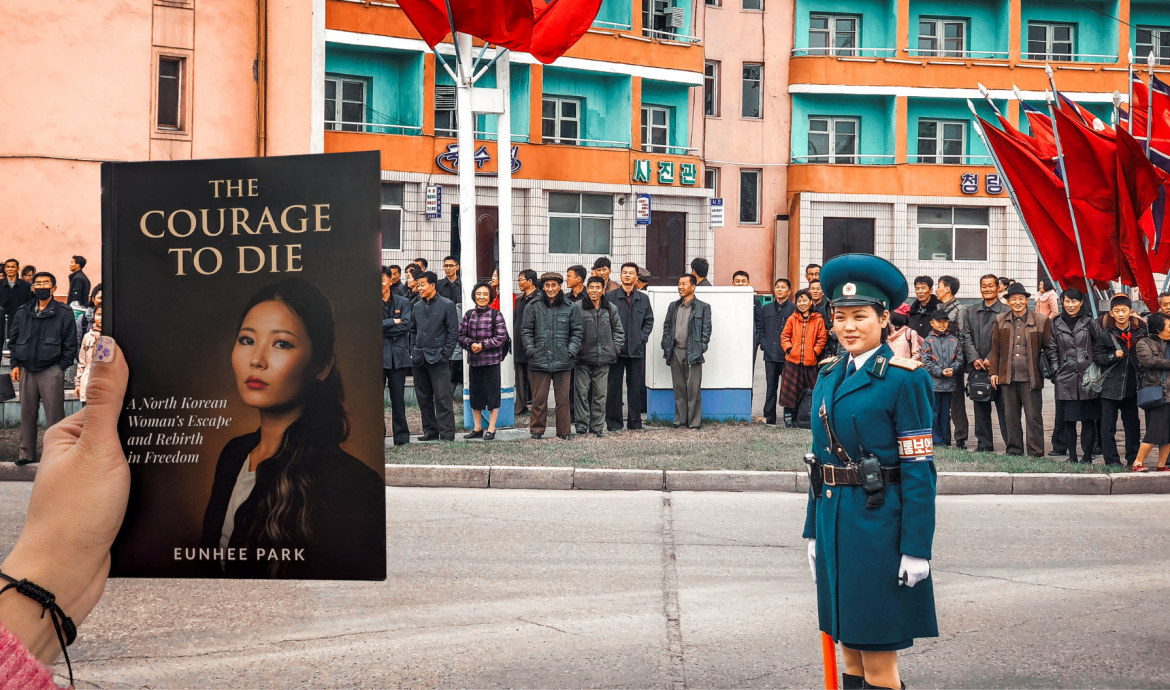
Ever wondered what life in North Korea is really like? If you’ve ever found yourself scrolling through social media and stopped on a video from one of those few content creators or journalists who actually managed to get into North Korea, you know that specific feeling of unease. We see the streets of Pyongyang and the grand statues, the staged restaurants and shops, but we almost never see the human soul behind the propaganda. We see the regime, but we don’t see the people. That is exactly why Eunhee Park’s “The Courage to Die” is such a massive, necessary read. It’s not polished in a literary, award-winning kind of way, and that’s exactly what makes it so powerful. This is the first self-published book by Eunhee Park, a North Korean defector who spent 21 years living inside one of the most secretive and controlled countries in the world before finally escaping.
You don’t read this book for beautiful prose or complex narrative techniques. You read it because it feels real. The writing style is incredibly straightforward, almost conversational at times. There’s no attempt to dramatise events or dress them up in poetic language. It’s just… life, as she lived it. When Eunhee describes hunger, she doesn’t over-explain it. She just tells you what she ate, or didn’t eat. When she talks about fear, she doesn’t philosophise; she shows you what fear looks like in everyday decisions. It’s this stripped-back storytelling that makes the book accessible, but also deeply unsettling. When you read her words, you realize that while the world moves on with iPhones and space travel, there is a whole population of people just across the border living in a time capsule of trauma and propaganda.
Eunhee Park’s “The Courage to Die” focuses on life during the North Korean propaganda ideology known as Juche. It’s one thing to read about this period in history through statistics or documentaries, but it’s something entirely different to experience it through someone’s personal memories. Eunhee was a child and teenager during this time, and her perspective captures both confusion and normalisation. Food scarcity wasn’t an occasional hardship. It was constant. Families had to find ways to survive that most of us can barely imagine. Loyalty to the regime, participation in propaganda, adherence to strict rules…all of that continued, even as people struggled to stay alive. In most countries, if you’re hungry, you go to the store. In North Korea, if you were hungry and didn’t have a “hustle,” you simply died. In that black market economy, even children had to become savvy traders just to survive.

North Korea And The Staged Reality
Another aspect that Eunhee Park’s “The Courage to Die” made me think about is how North Korea presents itself to outsiders. Tourists do visit the country (or they used to), but their experience is tightly controlled. They’re shown locations carefully selected, clean streets, the same impressive monuments, and organised performances. Everything is designed to create a specific image. Visitors aren’t allowed to wander freely or explore on their own. They’re not even allowed to take certain photographs. They must be accompanied by guides at all times, and even their conversations can feel monitored. And behind every polished façade, there’s a much more complex and often much harsher reality that remains hidden. Every interaction is choreographed. Every smile from a local is likely a survival mechanism. As a tourist, you are shielded from the “real” North Korea.
In most places, choosing what to eat, where to go, or what to say might feel trivial. In Eunhee’s world, those choices could have serious consequences. Even something as simple as expressing the wrong opinion or being associated with someone who did could put you and your family at risk. This constant pressure shapes how people think and behave. The book doesn’t present this in a dramatic, over-the-top way. It just shows you what it’s like to live under those conditions day after day.
The Moments With A Big Impact
There are so many difficult, heart-wrenching situations described in the book that it’s hard to pick just a few. Some are heartbreaking, others are deeply unsettling, and a few are almost impossible to forget. However, there were a couple of specific stories that left a massive impact on me and changed how I view the concept of “freedom.”
When I turned fifteen, I was finally brave enough to ask the question that had haunted me for the past five years: why was I treated like an orphan? One day, as I sat across from my grandmother during her monthly visit, I mustered the courage to ask, “Grandma…Why do I have to live in an orphanage when I have parents? In the winter, there’s no heating. We have to wake up at five in the morning and live like soldiers until ten at night. I’m always hungry. It’s always cold. Why did you send me to suffer here? (…) After a long pause, she replied, her voice trembling, “I’m sorry, Eunhee…I didn’t have the means to raise you. The orphanage director said they’d feed you for free, even send you to college. I truly believed that was the better path for you. Your mom is in the hospital, your dad has another family…and your grandfather and I are unable to raise you properly. You even need money to go to school these days. I’m so sorry.”
Why is it taboo for a woman to style herself? Why is following my heart a sin? Why can’t I choose my own life? (…) When my grandmother returned from her last visit in 2006, she told me, “In China, no one steals your bicycle if you leave it outside. People eat white rice with meat every day and wear all sorts of clothes. China is far better off than North Korea. Yet, they say South Korea is even better.” At the time, her words didn’t mean much to me. In school, we were taught that South Korea was our enemy – a place where people starved to death, and children were too poor to go to school. One chapter in our elementary textbook, titled “Vroom Vroom,” told us that North Korean children loaded food into a car to share it with the starving children in the South.
A giant screen hung on the wall in front of me. One day, it flickered to life with an unfamiliar map – a satellite image of my hometown, Wonsan.(…) I froze. I had never read a map before, not even on paper. Now I was staring at a glowing image of a city, every street and building spread out like an endless maze. (…) ‘Sir,’ I asked, ‘where did that screen come from? Was it a photo of a paper map?’ He smiled and said, ‘This is Google Maps. You can see it on the internet.’
‘Goo…gle?’ I repeated, tasting the strange word. ‘What is the internet?’ (…) That was the first time I heard the word ‘internet’ – the first hint of how vast the world beyond North Korea truly was.
It takes a specific kind of courage to not only survive that environment but to then have the strength to write about it and put it out into the world.
In North Korea, propaganda is not just something you see occasionally. It’s everywhere. It shapes how people think, how they speak, and even how they see the world. From a young age, citizens are taught what to believe, what to say, and what not to question. There’s no real separation between personal identity and state ideology. And that’s something Eunhee Park’s “The Courage to Die” captures incredibly well.

Beyond the Book: Following Eunhee’s Story Today
One thing I genuinely love is that the story doesn’t really end with the last page. If you finish the book and find yourself wanting more (which you will), you have to follow Eunhee on Instagram. That is where she continues to share insights, updates, and lesser-known facts about North Korea. And honestly, that adds a whole new layer to the experience. The book gives you the foundation, but her social media page highlights details and realities that aren’t always included in the book, either because of space or because they didn’t fit into the narrative at the time. And some of those insights are genuinely fascinating.
These are the most interesting facts and updates about North Korea:
- North Korea claims to protect people with disabilities. In reality, awareness of disability rights is almost nonexistent. There are testimonies that people with disabilities in North Korea are forced into isolation, used for medical or scientific experiments, restricted from moving freely, and even killed at birth in some cases,
- In free societies, homelessness exists. But there is still a system. There are shelters, food programs, and support networks. In North Korea, there is none.
- Today, out of North Korea’s population of about 25 million, around 6.5 to 7.3 million people use mobile phones. But the most important fact is this: these smartphones are not connected to the outside world. There is no internet and no international calling. They only work within the country’s internal network. The Arirang, Pyongyang, Jindallae, and Puren Haneul smartphones used are based on a Chinese Android system. Apps can not be freely installed. Only government-approved apps are allowed, and external content (such as South Korean dramas, K-pop, or various files) is automatically deleted. Automatic screenshots are taken every 5 minutes and stored in a hidden folder that the user can’t access.
- Officially, people have weekends off. But Fridays often mean being sent to rural areas for labour. Saturdays are for mandatory life review sessions, while Sundays can be taken away for political events.
- For many families, meals are simple and repetitive. Corn, rice, and potatoes make up most of the diet. Side dishes are usually kimchi, vegetables, or soybean paste soup. For most people, meat is not a normal part of life. It is something you eat on holidays or special occasions.
- Abortion was banned in 2015, but it never disappeared. Instead, it became dangerous, hidden, and often, forced.
- Actors and singers are not independent celebrities; they are state employees. There are no fan meetings or official fan clubs, as you see in a free country. The only person allowed to receive mass public devotion is the Supreme Leader.
- The Korean Children’s Union is a mandatory political organization for all children aged seven to fourteen. It functions like a small army inside the school.

Eunhee Park’s “The Courage to Die” is a story of resilience, survival, and what it means to live in a world where freedom is not a given right. It’s a simplistic, devastatingly beautiful account of a girl who decided that the risk of dying during an escape was better than the certainty of a slow death in a land without a voice. It makes you reflect on things you might normally take for granted. If you want to understand the North Korean people, this is the biography I would absolutely recommend. Not because it’s easy to read, but because it’s impossible to forget.




Definitely adding “The Courage to Die” to my reading list. Looking forward to the insights into North Korean life from her straight forward approach to writing.
Being written by someone who was actually born and raised in the country will give you a glimpse into how people actually live in North Korea. This in addition to the many other documentaries available online.
I would love to read this book and learn about life there. It’s hard to find information about it
North Korea is a very isolated country for tourists. The access inside its borders is not always available and when it is, you are only allowed to photograph and film only where you are given permission. However, books like this give us access to life as it is behind all those Instagram reels and videos.
I’m a huge reader and this would be exactly what I’d love to read
The memoir is easy to find on Amazon. However, I believe that there is also the possibility of getting a signed copy, together with a North Korean souvenir, if you DM Eunhee on Instagram.
This seems like such a unique read! I know very little about North Korea beyond the news, so it’s fascinating to get a glimpse of a real story. The quotes left a strong impression on me – I have a feeling this book is both unputdownable and deeply moving